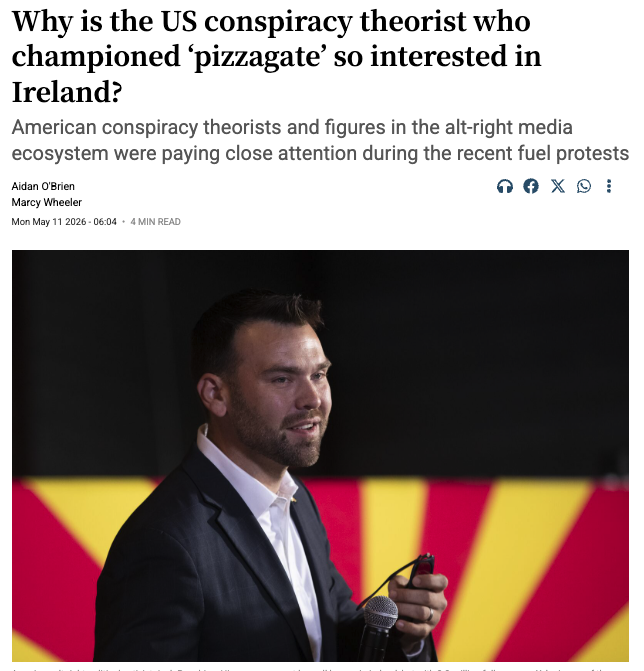
EDMO Ireland analyst Aidan O’Brien is featured in the Irish Times, co-authoring an opinion piece with Marcy Wheeler on the growing attention US far-right conspiracy influencers are paying to Ireland.
On the morning of April 7th, the first videos of the fuel protests in Ireland went viral almost instantly. In the US, the people who have spun stories of pet-eating migrants and paedophile ceremonies in Washington pizzerias immediately paid attention.
Highly influential American conspiracy theorists and figures in the alt-right media ecosystem used footage of the protests to spin narratives of “European civil war”, or claims that this was an “anti-migrant” or “anti-net zero” protest. Some of these individuals have close ties to the Trump White House, an administration that has announced its plans to protect hate speech in Europe, and by doing so, push American power in Europe.
Even before the tractor engines had started cooling, videos of the Irish fuel protests began going viral on social media.
In the years since the Covid-19 lockdowns, Ireland has developed its own thriving disinformation ecosystem, and online influencers started rapidly sharing videos and interviews from the protests almost before they started. Following close on their heels were international far-right influencers who almost instantaneously reshared the videos with their own narrative spin: claims that the protests were not about fuel costs but immigration; that Ireland is “the globalist regime’s guinea pig”; the protests were against “their government’s green new scam” or that the Government was intentionally bankrupting Irish farmers to cause “a deliberate famine”. False claims that the Irish Government had “allegedly frozen the fuel protesters’ bank accounts” circulated.
Elon Musk shared a tweet claiming that “entire towns and cities are now on the streets in Ireland opposing their far-left Government”, to which he added a one-word comment: “Good”.
The attention of one notable account in particular was drawn to the fuel protests. Between April 1st and April 27th, Jack Posobiec tweeted about Ireland well over 50 times, at least three times a day. Posobiec called the Irish Government “traitors”, claimed there was a “ project to ethnically replace the people of Ireland”, and repeatedly called for a revolution in Ireland.
Posobiec’s name may not be well known in Ireland, but with 3.3 million followers on X, he is one of the most prominent alt-right media conspiracy theorists in the US. He rose to fame during the presidential election there in 2016 by promoting what became known as “pizzagate” – the hoax that Democrats were hiding a child sex trafficking ring in a pizza joint.
Posobiec also played a key role – according to research on behalf of the Atlantic Council’s Digital Forensic Research Lab, Eurasia Center, Future Europe Initiative and the French Institute for Strategic Research (IRSEM) – in disseminating hacked files that Russian spies were later charged by the US with having stolen from Emmanuel Macron during his bid for election in France in 2017.
Posobiec was among the most prolific tweeters spreading false claims of US election fraud in 2020, a large propaganda campaign that led thousands of credulous Trump supporters to overrun the Capitol on January 6th, 2021. In 2024, he was associated with a false claim that Haitian workers in Springfield, Ohio were eating their cats and dogs, one that then-candidate Trump magnified in a debate. Posobiec also oversees the ultra-right conspiracy-promoting publication Human Events.
Kevin Posobiec, his brother, was dispatched to Ireland to cover the protests. Kevin mimicked his brother’s tactics when he posted a video insisting there had been a stabbing incident at Connolly Station, despite explicit denials from station staff; like his brother, he framed official denials as proof of a scandal, helping to amplify the false story.
Kevin spent time in Ireland interviewing key players in the fuel protests. On April 14th, he interviewed Independent Ireland TD Ken O’Flynn outside the gates of Leinster House.
“We have the best and the brightest … who are leaving the shores of this country, and what are we doing? We’re importing the worst of society,” O’Flynn said. “We need to drain the swamp,” he added, gesturing at Leinster House.
Steve Bannon was also paying close attention to events in Ireland. On his podcast on April 10th, he claimed immigration, not Trump’s war on Iran, caused the fuel protests.
Bannon’s interest in Irish affairs has been ramping up in recent years. In late 2025, he claimed that he was actively involved in establishing a new Irish “national party”, stating, “they’re going to have an Irish Maga and an Irish Trump… that country is right on the edge thanks to mass migration”.
A recent exposé in the Washington Post by a former right-wing social media influencer, Ashley St Clair, has laid bare how the Trump administration covertly orchestrates (with many of its favourite right-wing social media influencers) messaging to further its agenda. This agenda, which views the European Union as a hostile entity, is now actively pursuing the undermining of democracy and stability in Europe. Part of this consists of opposition to any measures by the EU to rein in social media companies’ power. The current US administration views such “interference” as an attack on infrastructure that is critical to its propaganda war.
Ireland’s historic links with the US, alongside our position as a key EU tech hub, v means that in any fight between the EU and US over social media, the country will be a key battleground. With Ireland about to take on the EU presidency in the summer, more attention than ever will be placed on this island. And with further fuel protests and disruption likely, the focus that came on Ireland back in April may be just the beginning.